|
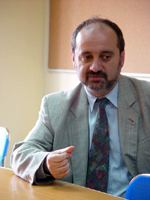
Question 1 (Bagdasarian L, Armenia): Good day Mr. Ladaria. You were introduced by our Georgian colleagues as the press ombudsman of the 24 Saati daily. Could you elaborate on your functions and how it correspondents with your professional taste for theology.
Addition: As to theology, it’s not a professional taste. I am an assistant professor of cultural studies at Tbilisi University of Language and Culture.
Question 2 (Guliyeva G, Azerbaijan): Your family was attacked in the Mtskheta district of Georgia on September 11, in your own apartment, and robbed of mobile phones, cash, jewellery, and a computer with your works. The perpetrators managed to get away with it. Criminal investigation is under way. What can you say about its progress?
Answer: The investigation stalled after I obtained a listing of calls from my phone. This document helped apprehend one suspect but he has refused to answer questions so far. My possessions have not been returned yet. Thank you for your personal attention to my problem.
Question 3 (Bagdasarian L, Armenia): And again, Mr. Ladaria, what are your functions as the press-ombudsman of the 24 Saati newspaper?
Answer: Generally, functions of the press-ombudsman may be described as follows: protection of the reader’s rights. Every reader must get authentic and understandable information. It’s not the only problem, however. Obviously, there is no such thing as absolute objectivity. That is why, the selection of materials, their design, etc, must comply with liberal values. For instance, I try to expose hostile language in my reviews, if it somehow shows up in the newspaper, even though it may be an exact quote of a politician’s statement. As a rule, I write a weekly full-page article with account of events of the past week and their media coverage.
Question 4 (Amirova L, Azerbaijan): Good day, you are disturbed from Baku. I am Leila Amirova. I represent interests of the Azerbayjanskiye Izvestia newspaper today. My friends characterise you as a man extremely concerned with the purity of Christianity. You once pointed to Seraphim (Jojua), the archbishop of Bakuriani, as an example of active opposition to the withdrawal of Russian military bases from Georgia. Are you Orthodox or pro-Western? Thank you for your answer in advance.
Answer: I do not understand why Orthodox and pro-Western should be viewed as contradicting each other. I can cite a dozen of famous examples. I think it would be enough to name Berdiayev and Bulgakov. As to the Bakuriani archbishop Seraphim, it’s a different problem, which has nothing to do with the purity of faith. Analytical journalism, capable of examining the relationship between the Church and politics, is lacking in Georgia. That is why this relationship is sometimes dangerous and sometimes comic. I think that the purity of faith will only benefit, if the Church abstains from contacts with foreign security services (such contacts are exposed, directly or indirectly, quite often).
Question 5 (Bagdasarian L, Armenia): The role of religion has obviously increased in all post-Soviet societies in recent times. “The need in faith” (it may be not a very good formula) has become stronger. Out of all the cities I have been to, however, Tbilisi is the only one where people cross themselves every time they pass a church, walking down a street or in public transport. How can you explain this phenomenon?
Answer: It can be explained by social rather than religious reasons. The main objective of the Georgian Orthodox Church is to maintain its social and political positions, because otherwise it would be hard to satisfy material needs of its leadership. Under such circumstances, the Church is interested in propagating a very narrow and superficial form of Christianity, limited to some ritual gestures and unconditional homage to the clergy. Self-crossing in public transport is just an attribute of this form of Christianity. The less people understand, the better the clergy live.
Question 6 (Guliyeva G, Azerbaijan): I apologise for not introducing myself during my first question. I am Gulnaz Guliyeva of the Caspian Business News newspaper. Speaking at a conference in Rome recently (your mindset has hardly changed since then), you told the attending theologians that the current reality is permeated by achievements of the Christian culture. You said that these achievements were essential for human perception, as all modern communication means, regardless of their religious or cultural origin, had their roots in Christianity. These are strong words. But what about non-Christian civilisations, which are older and different from the “Christian base”?
Answer: Dear Gulnaz, I cannot assume responsibility for the world’s fate. I only voiced a very simple idea, which can be illustrated as follows: only the Christian civilisation felt ashamed and sad when the Taliban destroyed the colossal monuments of the Buddha. On the other hand, but for the Christian civilisation, the only mass consumer of crude oil, the “black gold” would be used only in primitive torches and folk medicine. Some thinks require a penetrating mind to achieve results.
Question 7 (Bagdasarian L, Armenia): I don’t have any specific data on Georgia but a conflict between the Orthodox religion and the so-called new denominations, such as Jehovah Witnesses, etc, is evident in you country. Could you elaborate on the respective situation in Georgia and public attitudes towards these denominations? What is the Church’s policy in this respect?
Answer: This theme is very important. Send me, please, your e-mail address. I will try to arrange contacts for you with the people dealing with the problem. I can say that in recent times (in the post-revolution period) these problems have become less visible but not less urgent. They moved to a different dimension. As mentioned above, the Church is concerned with its financial situation under the new government. At the present stage these conflicts have been somewhat marginalized and moved to the backstage. Respectively, they became harder to reveal and prevent. At the same time, the society has improved little so far. It simply diverted its attention from the problem. So, from the viewpoint of religious minorities, the situation has not improved yet.
Question 8 (Amirova L, Azerbaijan): You were sued last year. I recall this case because it is unprecedented for Azerbaijan – the state minister has never brought an action against the press ombudsman here. The lawsuit was brought by Guram Absandze, the minister for national reconciliation at the time (the fact upset my friends and my, and drew comments in the Azerbaijani newspapers). You were accused of having insulted members of the movement, which was formerly led by Zviad Gamsakhurdia. Allegedly, you described the act of national reconciliation in the Kashveti Church last spring as a farce and labelled the former president Zviad Gamsakhurdia’s supporters as “rabble”. It’s a rather complicated case. Can you clarify it? Thank you.
Answer: The state minister did not bring any lawsuits. He was well aware that no court would agree to hear the case, even though it was filed by the state minister. Much worse things can be usually heard at rallies of the Zviadists. For the last several months they have staged a long protest rally in front of the Soros Foundation in Tbilisi, chanting astonishing words about a Masonic conspiracy against “holy Georgia”. This vindicates that I was right to assess the reconciliation as a farce. By the way, as soon as they spot me, participants of the rally begin to chant: “Down with Ladaria!” I regard it as a demonstration of the nationwide recognition. As to the word “rabble”, I think that it is a problem of Russian translation. However, there are as many rabble as in any other social group, though I do not like using such terms.
Question 9 (Bagdasarian L, Armenia): Your formula “The less people understand, the better the clergy live” reminds of, sorry, Marxist-Leninist or some other, not theological, expression. The deeper insight in theology, the greater distance from the Church – is it so? Do you have any other explanation?
Answer: There may be many explanations. I will try to make myself clear: apart from the purity of faith, there is also understanding of the faith, religious culture of the secular society, which must be high enough for the Church to perform its functions in a normal way, in line with the principles of the New Testament. However, when people are told that it is quite enough to cross themselves when passing a church or to fast, that just this is the “Law and Prophets”, they become a flock without understanding their true mission and without dignity or without its right perception. It’s easy to make personal profits in such a situation: to sell drugs, launder stolen money, or reach agreements with criminal organisations. Even if the illegal deals are exposed, the dopey flock will not stop it support.
Question 10 (Martirosian S, Armenia): Good day, Mr. Ladaria! This is a question from Open Armenia. The press has reported recently about Armenian-Georgian conflicts in Georgia, which stemmed from the rows over origin and ownership of churches. How serious is the problem? Does the conflict have real grounds or it is groundless?
Answer: The conflict is not groundless. I do not know the current situation but the problem may have very serious consequences. I have repeatedly denounced Armenophobic statements of some Georgian clergy. However, when a priest of the Armenian Apostolic Church made a similar statement, he was recalled from Georgia at the demand of the Georgian Partiarchat. He was the only man fluent in Georgian. I would appreciate if you investigate the issue.
Question 11 (Guliyeva G, Azerbaijan): David Paichadze, one of the authors of our analytical magazine “Caucasus Journalists”, argues that you are outspoken about isolationist policy of the Georgian Orthodox Church. Is it a result of the activities of Alexey II and “his team”? Many Orthodox communities, including the Istanbul Diocese, are unhappy with the policies of the “monarchical” Russian Orthodox Church. Explain, please, the motives for your remarks.
Answer: Your assessment of the activities of the Russian Orthodox Church is absolutely correct. As to the motives, I was motivated by facts. When Alexey II decorates the head of the FSB with a supreme church award, stating that the church and security services have similar missions, an honest man hardly needs other motivations, does he?
Question 12 (Bagdasarian L, Armenia): As the press-ombudsman and a theologian, you must have noticed facts, or talks, that the Armenian churches of Tbilisi are, to put it mildly, “overlooked” by the Georgian society, and maybe authorities. Our newspapers wrote that the Khodjevan Pantheon did not receive proper care during the construction of a Georgian church in the same area. A correspondent of the “Aravot” newspaper photographed remains of a human skull near a path leading to the new church. I have seen the photo. What is to be done?
Answer: I agree with you. Ancient Roman Catholic churches are in the same situation. The alliance of the church with the government is the main problem here. The latter views the church as the strongest leverage to influence the voters. So one needs to influence the government in order to rebut this illusion. Support of the Ukrainian Church may become one of specific steps in this direction. Elections in Ukraine demonstrated that the government’s religious neutrality is more efficient than support for a particular church. This method does not have a direct effect, to be sure, but it must be undoubtedly applied.
Question 13 (Martirosian S, Armenia): Does it mean that the Armenian Apostolic Church is not in control of the situation, at least because its representatives in Georgia are not competent enough?
Answer: Yes, it does. However, passiveness rather than incompetence plays a more important role here. On the other hand, a wise and self-restrained Armenian bishop, as a representative of the AAC, could be very helpful here.
Question 14 (Bagdasarian L, Armenia): Thank you for candid answers. I hope you will answer the next one too. It is about the so-called external attributes, mentioned above. When high-ranking governmental officials attend religious services – they do it not only in Georgia, believe me – is it also an external attribute or a sign that the church and the state have the same goals, despite their constitutional separation from one another?
Answer: I agree with this remark too. I think that our societies are not fully aware of the meaning of the word “constitution” yet. Small wonder. Without religious wars of the XVII century, which axed Germany’s population from 20 to 6 millions, Europe would have hardly realised that nations should seek common ground, while state-building must be based on political unity of interests. Unfortunately, our societies are governed by ethnocratic rulers. The church is a ready external expression for ethnocrats. As a rule, they do not bother to understand the true matter of faith.
Question 15 (Bagdasarian L, Armenia): How do you think, what kind of serious consequences Armenian-Georgian rows over origins and ownership of a particular church may bring about?
Answer: The problem has nothing to do with churches. The main problem is the so-called “effect of butterfly”, i.e. growing tensions in the South Caucasus, which are beneficial only for Russian interests in the region. On the whole, to avoid accusations of paranoia, I can add that even if only a dozen of people are unable to worship in a place legally owned by their ancestors in the past, it is quite a legitimate reason for indignation. Even for those who consider themselves superior to these people by virtue of their education and beliefs. Thank everybody for your interesting questions. I have got an impression that I talked to worthy and welcome colleagues. I was especially impressed that your side was well prepared. Best wishes. Looking forward to meeting you in person. Nodar Ladaria
Question 16 (Bagdasarian L, Armenia): You did not give a clear answer to my question. But I understand you. The issue of Armenian-Georgian relations is so sensitive nowadays that one has better abstain from pessimistic assessments in order to ward off the evil eye. Seriously speaking, however, I have another question. Are your articles, as written by the press-ombudsman, adequately interpreted by the society, and by journalists themselves, or you are treated as, sorry, a social outcast for your monitoring of the hostile language in the Georgian papers?
Answer: I cannot but answer this question. I have both supporters and enemies. It’s a normal situation. I have heard a lot of different things about myself, but I am not an outcast. At least I have no reasons to claim that I am. Quite the contrary, there are other reasons for regret. It’s bad when serious bullying is lacking and one has to carve an ecological niche for oneself, which... It reminds of an anecdote: “We have already a Jew and a girl”. Anyway, I am not going to stop and will become even more radical. See you!
|